
Teen Acne
7 Things Every Parent Should Know Before Considering Accutane for Their Teen
A pediatric dermatologist on why topicals keep failing your teen — and the four-pillar approach more of us are recommending before Accutane.
 By Dr. Elena Marsh, MD·Board-Certified Pediatric Dermatologist·Last updated May 27, 2026
If your dermatologist has started using the word Accutane, this article is for you.
I've been a board-certified pediatric dermatologist for nineteen years. In that time, the conversation about teen acne has changed more than the standard treatment ladder has — and there is now an intermediate step between "topicals that aren't working" and "a drug with serious side effects" that most parents are never told about.
These are the seven things I need you to know before that next appointment.
You haven't been failing. The standard treatment ladder has been failing you.
You've tried the topical cleansers. You've probably tried Differin or tretinoin. Maybe a course of antibiotics. Possibly the newer trendy skincare brands.
The pattern is always the same: a new product seems to work for a few weeks. Then it stops. You try the next one. Same story.
The products didn't fail because you picked the wrong ones. They failed because of what they are.
Every topical works on the surface of the skin. None of them reach where teen acne actually starts. Trying a different topical when topicals as a category cannot reach the cause is like mopping a flooded bathroom while the faucet is still on.
You haven't been failing. You've been mopping.
Where teen acne actually starts.
In medical school, we were taught to treat acne from the outside in. Cleanser, antibiotic gel, retinoid, escalate as needed. The protocol has not meaningfully changed in 30 years.
It misses what's actually happening.
During puberty, the sebaceous glands begin producing three to five times more oil than they did a year earlier. That oil mixes with dead skin cells inside the pore. Bacteria multiply in the sealed pocket. The immune system responds with inflammation. The cyst on her chin is the end of the chain.
Now look at where each step happens: the oil overproduction is deep in the sebaceous gland. The trapped cellular debris is inside the pore. The inflammation is in the dermis.
A cream reaches none of those layers. It reaches the surface, where the damage has already been done.
This is why the math never works in your teen's favor. The topical is clearing yesterday's breakouts while her glands are producing tomorrow's. If she's been on a consistent topical regimen for 90 days and her skin is not significantly clearer, more time will not change the outcome. The mechanism is wrong.
The four internal drivers — and why Accutane works (and why it's so harsh).
This is where most parents stop reading and most articles end. But this is also where the actual conversation begins — because if you understand what's happening underneath the skin, the rest of this article will change how you make the decision in front of you.
There are four biological drivers that determine whether your teen's skin clears or stays in the cycle. Any treatment that addresses only one is structurally incomplete:
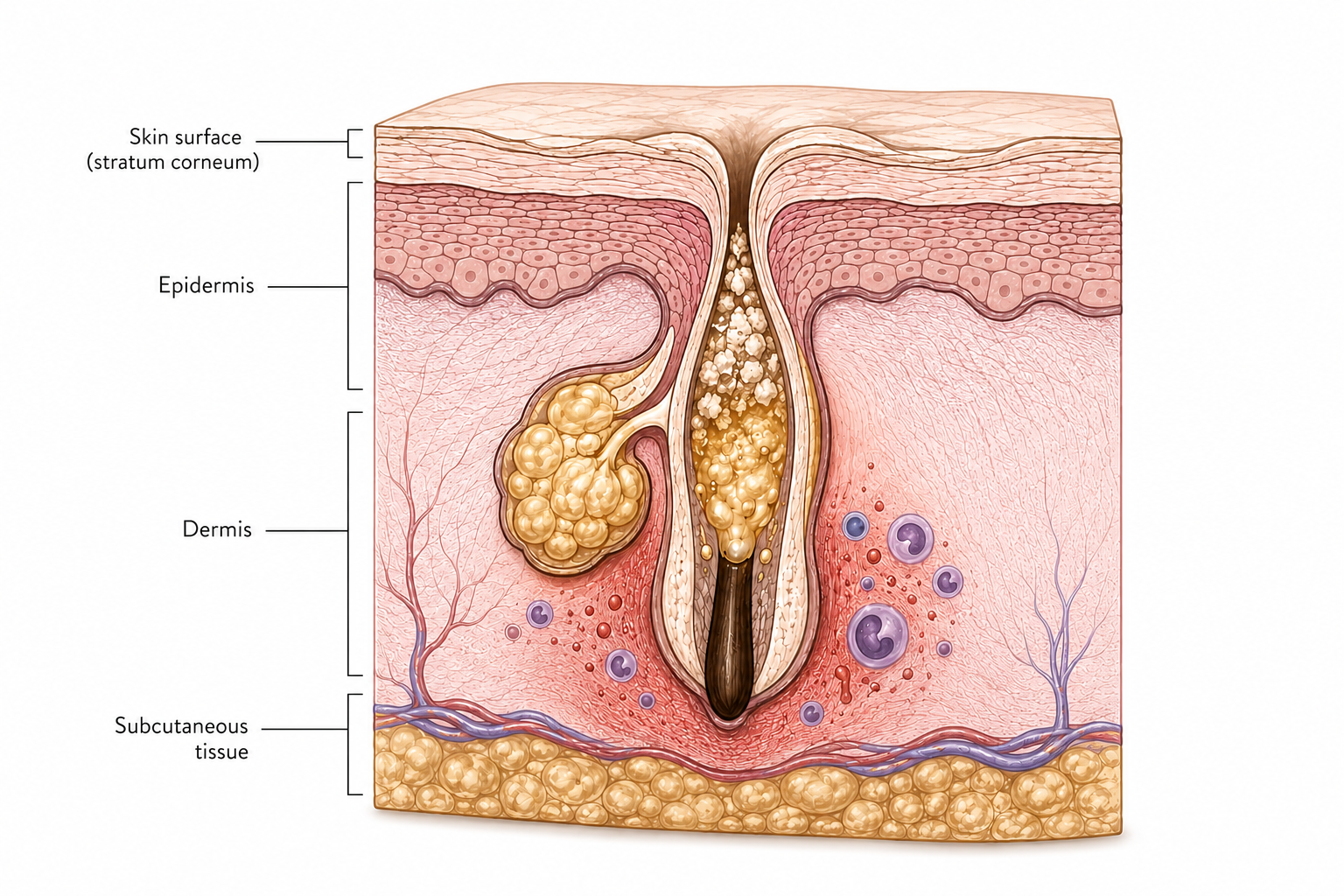
- Sebum overproduction. During puberty, oil production increases three to five times. Excess sebum mixes with dead skin cells inside the pore, creating the sealed environment where breakouts form. This is the upstream event. Without addressing it, every other intervention is downstream cleanup.
- Impaired skin cell turnover and immune function. Teen skin sheds cells faster than adult skin, and those cells need to clear the pore properly or they trap oil inside. Immune function inside the pore determines whether bacteria colonize the trapped oil. Both processes depend on nutrient sufficiency that most teen diets do not provide.
- Oxidative stress. The inflammation that makes breakouts red, swollen, and slow to heal is driven in part by oxidative damage at the cellular level. This is also what causes post-inflammatory marks to linger for months after the breakout itself has cleared.
- Skin barrier dysfunction and oil imbalance. A compromised skin barrier produces more oil to compensate, and that oil is chemically different — thicker, more occlusive, more likely to clog. Most topicals damage the barrier further, which is why the "strip oil and it produces more oil" cycle that frustrated mothers describe is biologically real.
Now look at the standard ladder against this framework:
- Topical antibiotics: address inflammation slightly. Three drivers untouched.
- Retinoids: address sebum chemistry partially. Three drivers untouched.
- Oral antibiotics: address inflammation. Three drivers untouched. Plus they disrupt your teen's gut.
- Birth control: addresses sebum signaling for girls. Three drivers untouched. Plus significant side effects under 16.
- Accutane: addresses multiple drivers. Which is why it works — and why the side effects are significant.
Accutane essentially shuts down sebaceous gland function entirely. A sledgehammer that addresses several drivers at considerable systemic cost.
The gap between "topicals that can't reach the cause" and "Accutane, with serious side effects" has been empty for decades. That gap is what the four-pillar protocol is designed to fill.
What Accutane actually involves.
I prescribe Accutane. For severe nodulocystic acne that has failed every reasonable intermediate step, it can be the right call.
For moderate teen acne where intermediate options exist, you deserve a clearer picture than most parents receive.
The documented profile, from peer-reviewed sources and what I observe in my own practice: joint pain that often persists after treatment ends. Severe eye dryness that often persists. Mood changes and depression risk that require monthly monitoring. Liver enzyme elevation that requires monthly bloodwork. For female patients, severe birth defect risk that requires contraception throughout treatment — which in practice means starting your 14-year-old on hormonal birth control she didn't otherwise need. Documented effects on bone metabolism in pediatric patients, including reduced bone mineral density. Documented cases of growth plates closing prematurely in teens who started Accutane during a growth window.
"The scary thing about isotretinoin is that the side effects do not stop once you stop taking isotretinoin."
For a still-developing 13-, 14-, or 15-year-old, you deserve to know what intermediate options exist before consenting to a drug with this profile.
What changed in pediatric dermatology — and what I now recommend in my own practice.
For most of my career, I rarely recommended supplements. The category was full of underdosed products with no clinical rigor.
That has changed in the last five years.
There are now formulations rigorous enough that I include them in treatment plans for patients with moderate teen acne who have failed topicals and are not yet at the Accutane threshold.
The criteria I use:
- Formulated by pediatric dermatologists, not marketing teams
- Clinical doses that match published evidence in pediatric populations — not the trace amounts found in standard teen multivitamins
- All four pillars addressed in a single formula — because no teen will take four to six separate supplements daily and remain compliant
- Teen-calibrated dosing for ages 12–17, with safety margins appropriate for developing endocrine systems
- Third-party tested for purity and potency
Of the products I've personally reviewed against these criteria, Klera is the one I now recommend.
It meets every one: pediatric-dermatologist formulated, clinical-dose zinc picolinate at 20mg for sebum regulation, vitamins A and D3 for skin cell turnover and immune function, a three-nutrient antioxidant stack for oxidative stress and post-breakout healing, and niacinamide with pantothenic acid for barrier function and oil balance. All four pillars in a single daily gummy, third-party tested, calibrated for teen biology.
What I've seen in my practice
Patient case
Madison, 14. Two years of topicals before her family came to me. Cysts on jawline and chin, mild scarring beginning. Started the four-pillar protocol while continuing a gentle topical. At her 90-day follow-up: substantial clearance on her cheeks and jawline. No new cysts in six weeks. We never started Accutane.
Patient case
Jacob, 16. Severe back and shoulder acne — the kind that had him quitting basketball because of locker-room embarrassment. Three rounds of oral antibiotics with diminishing returns. Started Klera. His mom called me at week 6 ready to quit because she wasn't seeing enough change. I asked her to give it to week 9. By week 10, his back was clearer than it had been in three years. He went back to basketball.
Patient case
Sophia, 13. Hormonal jawline acne starting at the worst possible age. Her general pediatrician had recommended starting her on hormonal birth control to manage it. Her mother had already filled the prescription. She called me for a second opinion before starting it. We tried the four-pillar protocol first. By twelve weeks, her skin had fully cleared. The birth control prescription is still in her mother's drawer, unfilled. The last time I saw her in my office, she told me she finally feels like herself again — she's confident, she's not hiding behind her hair, and she said for the first time in two years she doesn't think about her skin every time she looks in the mirror.
The four-pillar protocol works on a hormonal timeline, not a topical timeline. The most common reason families don't see results is they quit at week 6 — exactly when the internal changes are starting but haven't surfaced visibly yet.
These are not unusual. They are the typical outcomes I see in patients with moderate teen acne who complete the full 90-day protocol. A 2021 parent survey of families with teens with severe acne found 93% worry about permanent scarring and over 90% are very worried about the impact on their child's wellness — and the families whose teens respond to internal protocols are the ones who avoid those longer-term consequences.
The realistic timeline
This is why Klera is sold as a 90-day protocol. A 30-day trial cannot tell you whether the four-pillar approach is working — the cycle requires more time to shift.
What I'm going to say next is the question most parents ask me at this point in the conversation, so let me answer it directly.
Why I'm comfortable putting my name on this recommendation.
I get asked regularly why I publicly recommend a specific product. For most of my career, I didn't recommend any.
Between 2023 and 2025, I personally evaluated four pediatric acne supplement formulations against the clinical criteria I outlined in section 5. I rejected three of them.
Two failed on dose or composition. One contained zinc but at sub-therapeutic levels that wouldn't reach effective serum concentration in a teen. Another was formulated for adult hormonal acne and contained ingredients I would not prescribe to a developing 13-year-old — including DIM, which lacks adequate pediatric safety data. The third was a single-mechanism product that addressed oil regulation alone, ignoring the other three drivers — useful, but structurally incomplete by the four-pillar framework.
Klera was the one I approved. It met every criterion: pediatric-dermatologist formulated, clinical doses calibrated for teen biology, all four pillars in a single daily gummy, third-party tested, and built around the structural framework rather than a single mechanism.
I now have hundreds of patients on the protocol. The standard of care will eventually catch up. In the meantime, parents who know what to ask for can access the intermediate step now.
What this looks like 90 days from now.
The mothers I see at the 90-day follow-up tell me the same things.
They tell me they stopped having the morning conversation about whether their teen had remembered to do her routine. They stopped sniff-checking products before the next prescription pickup. They stopped Googling acne treatments at 11pm. They stopped feeling like they were failing as a parent every time a new cyst appeared.
But what they really want to tell me is what their daughter is doing again.
She let her grandmother take a picture at Thanksgiving without asking to redo it. She wore her hair pulled back to school for the first time in a year. She tried out for the school play. She stopped wearing foundation to bed because she said she didn't need it anymore. She looked in the mirror and smiled — and didn't immediately look away.
These are not promises about your specific teen — every case is individual. But they are what I see, consistently, in my own practice. And they are the outcomes that make me put my name on this recommendation.
And then they ask me about cost — because by this point in our conversation, they've usually spent more than they want to admit.
The 90-day protocol is $103. For context: the average family I see in my practice has spent between $600 and $1,200 on topical regimens before they reach my office. An Accutane course runs $1,500 to $3,000 in copays and monthly bloodwork, not counting the long-term cost of managing the side effects I described in section 4. The cost of trying the intermediate step before committing to the harshest one is the easy math in this decision.
If your teen has tried topicals and you are looking for an intermediate step before Accutane, this is what I recommend my own patients begin with.
P.S.
If your teen has been on a consistent topical regimen for more than 90 days and her skin hasn't significantly cleared, more time will not change the outcome. The mechanism is wrong.
The four-pillar protocol is what I recommend my own patients begin with before considering Accutane.